
I’m in the process of moving the Life in the Tropics blog over to my cyberbali.com domain. Using my own domain gives me a few options that I don’t have on WordPress like advertising for my two eBooks. If you are one of the regular readers of this site, please check out the new site over at Life in the Tropics.
The International Teacher: A Guide to Teaching Overseas
•October 20, 2009 • 3 CommentsThe International Teacher – A New eBook
Life overseas. Schools with first class facilities. Dedicated and polite students. A salary and lifestyle that allows you to put some money in the bank every month. An opportunity to expand your professional and personal horizons. New experiences waiting for you every day.
Does this sound like something that you want? If it is, read on.
 So, how do you have a terrific time while making a great living? International teaching is your portal to a life of adventure, professional development and financial security. Jobs for teachers overseas continue to increase as new international schools open around the world. However, as opportunities increase, obtaining a job as an international teacher is more competitive than ever. Teachers need to be prepared for the competition, which is why I wrote this eBook.
The International Teacher: A Guide to Teaching Overseas, ha 430 pages of up-to-date reviews of 155 international schools along with key articles on topics of fundamental importance to teachers searching for positions in international schools. In Section One of The International Teacher you will find articles on:
1. Finding the Fit
2. Writing a Cover Letter
3. Job Fairs
4. Interviews
5. Professional Development
Section Two contains articles on International Education Organizations including:
1. The University of Northern Iowa Placement Service for Educators
2. Search Associates
3. International Schools Services
4. East Asia Regional Council of Overseas Schools
5. International Baccalaureate Organization
6. Quality Schools International
7. Oasis International Schools
Section Three contains reviews of 155 international schools from five continents. Each school review contains:
1. Coverage of the school mission, facilities, curriculum, extra curricular activities, technology, professional development, employment details, and sociocultural information about the school’s location.
2. Updated links to the school website, employment information, email addresses, and more.
Why You Should Buy This Book!
This eBook is in downloadable PDF format with hyperlinks that allow you to instantly access the most recent information on 155 schools. The articles in Section One cover the most important aspects of finding an international job and allows you to be competitive in a highly competitive market. My years in international education have given me an insider’s knowledge of the international teaching market. As a retired teacher commented on a pre-publication of this book:
I wish that you had written this during my teaching years. The ease with which I was able to access information on so many schools, including ones that I have never heard of, would have made my job searches much more enjoyable and wide-ranging than they were.
A long-time international teacher commented:
An excellent resource for teachers looking for schools. Well written with witty comments and comprehensive. Cool images, which make most eBooks I have seen look positively dreary. A good buy!
For some examples of what you will find in The International Teacher go to my blog, The International Teacher. You will find reviews of schools as well as articles on teaching overseas. This eBook grew out of The International Teacher blog and covers more schools in greater detail with the most current information available. Plus, as a benefit for all purchasers of this book, you will receive next year’s update (due out in October 2010) for free. You can download two free sample chapters here and here.
About the Author
 I have a Ph.D. in anthropology, and I’ve been teaching now for 33 years. My positions have ranged from preschool to university. I’ve been overseas now for 20 years. In that time, I’ve taught just about every subject that schools offer. My first position overseas was teaching Second Grade to a group of expat students in a small mining community in Indonesia. Since then I’ve taught computers, math, anthropology, physical education, art, library, social studies, science, health, and more. I’ve been a computer coordinator at four schools, an elementary/middle school principal at two schools, and I’ve served on countless accreditation and curriculum committees as well. As a teacher and administrator, I’ve been on both sides of the job search – interviewer as well as interviewee.
You can find the details about purchasing and downloading this eBook by clicking on this link. You can have your own copy of The International Teacher in time for the international recruiting season that starts in December. The price of this valuable book is only $10.00. If you buy it now, you will get future updates for free.
 Buy This Book Today! (And You Might Be Shopping in Dubai Next Year)
Do you really want to keep teaching in your home country?
Payment is via PayPal.The price is only $10.00 and remember that you get all future updates for free by purchasing the first edition now.
Best of luck in your search for an international teaching position.
It’s Friday
•October 16, 2009 • 4 CommentsFinally, another Friday. I’ve never been a TGIF person, but my situation here in Sumbawa has led me to focus on Fridays as the goal for the week. Why? It’s one week finished in this rapidly disintegrating school, and one more week closer to getting back home and out of here.
Over the years, I’ve had many different jobs: some of them I loved, some of them I liked, some of them I disliked. I’ve only had one job before this one that I really despised. This school is the poster child for dysfunctional schools. Leaders that show up on the clock instead of early to inspire and check out the troops; a board that is incompetent and has no idea of what education should be; teachers that are demoralized and unsure of where their place in the future of the school is; a lack of vision when vision is sorely needed.
Well, I could go on, but this school will be just a bad memory in a few months.
I have a few days to work on tweeking the school blogs so that they are more user friendly, and I have the weekend to work on finishing my book about international education, which will be on sale soon here and on my other blogs and websites.
Who says life in the tropics is always fun?
Back in Sumbawa Redux
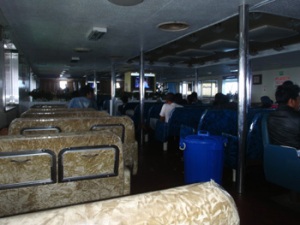
•October 6, 2009 • Leave a CommentI’ve been back in Sumbawa for a few days now. The trip over was extremely unusual in that the land part of the trip on each section was faster than usual, but the total time reached the longest time ever. That was due to a two-hour wait outside Lembar for docking, and a two-hour wait in Kayangan to board the ferry to Sumbawa. I’m still sore and tired from the trip. It may have something to do with aging. But, the ferry from Bali to Lombok was comfortable, and I did get an hour of sleep.
 Being back in Bali was wonderful. I did the usual stuff of changing light bulbs, making small repairs, helping the kids with homework, having meals with the family, and just generally hanging out.
Our house in Bali is far from plush, but it’s comfortable and we have great views of the mountains to the south and the sea to the north.
Now I’m back in townsite – not my favorite place, but it serves as home while I make some money for the family. But, I love Sumbawa; every time I come across the straight from Lombok to Sumbawa, I’m thrilled to see the Sumbawa coastline.
So what is it now? Six years or more that I’ve been here. Really, it doesn’t make that much difference. It’s somewhere around six years.
Another 10 weeks and I’ll be back home, and it won’t be too soon.
Schedules, Plans, and Organization: A Life in Retirement
•September 30, 2009 • 2 CommentsI just finished reading a biography of George Washington (Patriarch), the first president of the United States. Washington’s retirement was a period of his life that is especially interesting for me as I am coming up to that period in my life once again.
Besides worry about finances, Washington had numerous relatives that he assisted in one way or another – often financially even though he was relatively strapped for cash, but also with the advice that those of us who reach old age are apt to give quite freely.
To his grandson, a young man who was less than energetic in advancing himself, Washington wrote, “System in all things should be aimed at, for in execution it renders everything more easy.” After some specific advice on how to deal with his days, Washington concluded his letter by noting, “Time disposed of in this manner makes ample provision for exercise and every useful or necessary recreation.; at the same time that the hours allotted for study, if really applied to it instead of running up and down stairs and wasted in conversation with anyone who will talk with you, will enable you to make considerable progress in whatever line is marked out for you…”
Right, schedules, plans and organization. It seems to me, just from the short periods that I have been retired during my several attempts at such a life, that it is exactly this organization that is needed in order to stay happy, alert and productive once the routines and adventures of employment are passed. I’ve been working on a new set of routines myself over the past two weeks of my last vacation before retirement.
I’ve had a number of conversations with other expats who are reaching, or have already reached, retirement about how to adjust to this new stage of life. When I retired last year, I made a long list – about 41 points, if I remember correctly – of projects that I wanted to work on during my retirement. Similar to my approach to teaching – always better to over plan than under plan – there was no way that I was going to get to all of the activities that I had planned, but I was never going to be at a loss for something productive to engage my somewhat restless nature.
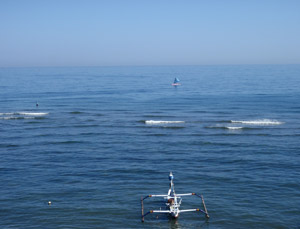 So, what are the routines that I’ve come up with? Here’s a look at the schedule that I’ve worked out.
5:00 – Wake my wife who then makes breakfast for the kids and gets them off to school. I go back to sleep for two hours.
7:00 – I wake up, open all the windows to my office/bedroom, put the bedding and pillows out on the balcony to air out, and check email and websites. If the sea is good, I go snorkeling for an hour.
8:00 – My wife and I have breakfast together and discuss what needs to be done for the day.
9:00 – I go upstairs to clean the third floor and then work on whatever writing project I have.
11:00 – I watch the news for an hour while answering correspondence.
13:00 – My wife and I go out and do whatever errands we have for the day such as going to the bank, shopping, or whatever else there is for the two of us to do.
14:00 – I read for an hour.
15:00 – I take an hour nap.
16:00 – I work on my writing projects again.
17:30 – The children usually come up to the third floor to watch the sunset and talk.
18:30 – Family dinner
19:30 – I retire upstairs to watch TV and edit whatever I have written during the day.
21:00 – I get all the children ready for bed, check on what they have planned for the next day, and then watch TV or read.
24:00 – I go down to the family room to wake up my wife who has already been asleep there for several hours and we go upstairs to sleep.
This is the basic structure of a regular day. Sundays are somewhat different as the kids don’t have school, and I often go fishing with Sam in our little sampan, or we go snorkeling together. On Sunday evenings, the kids come up to the third floor and we watch a movie together.
I’ve found that the days are most satisfying when organized in this way: I’m engaged and generally happy because I’m happiest when I’ve felt that I’ve accomplished something and there is some order in the world.
Do other retired expats have schedules that they adhere to? Let me know.
A Busy Week in Kampung Bugis
•September 28, 2009 • 1 CommentI’ve been back now for 9 days, and I’ve been busy with all sorts of activities. I spent the first few days here recovering from the trip over and the bad sunburn that I acquired on the ferry from Lombok to Bali. There were a few days left of fasting and then Lebaran. This year the weather held up (no rain like we always seem to have when we’re planning on praying outside), and the family piled into the car and went off to pray. The kids love Lebaran – it’s the closest thing to Christmas that I can think of for Muslim kids. We had lots of guests and everybody was happy that another Ramadan was completed successfully.
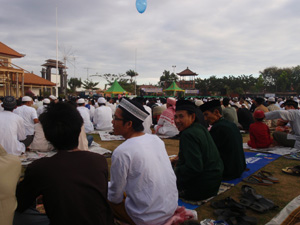
ramadan in singaraja
The Bali Sea hasn’t been all that hospitable for snorkeling and fishing so I haven’t been out yet. Sam and I were going to go fishing today, but the sea is a bit too choppy, and I know that Sam would be seasick within minutes of getting out on the sea. I hope to get at least a few days snorkeling before I go back to Sumbawa.
I’ve been thinking, too, about a few folks that I know who insist that they could never retire because they wouldn’t have anything to do, or to use that word that I tell my students never to use, because they would be bored.
I’ve been looking around for the list I did last year about what I was going to do when I retired. Well, it’s somewhere around here, but I never even got started on what I wanted to do in the five months that I was retired. I can’t wait to get back to working on doing the things on that list again. Ah, retirement.
One More Sumbawa-Bali Road Trip Under the Belt
•September 20, 2009 • 6 CommentsIn the last post, I wrote about leaving for home; I’ve been home now for three days resting up from the trip over from Sumbawa. This time it took me 15 hours and 45 minutes to make the 300 km drive that includes two ferry crossings. I left the apartment in Sumbawa at 2:15 A.M. and arrived at the house in Singaraja at 6:00 P.M.

bali from the ferry
Apparently the ferry that I took is one of the new ones so there was a group of important people around the harbor along with a television crew. I managed to get a seat in an air-conditioned cabin, but it was filled with screaming children and lots of adults throwing up. The “important people” took a tour of the ferry and ended up in the air-conditioned cabin. One person, who was obviously the most important, noted to a reporter that the cabin would be very popular with “bules” (the somewhat controversial term that many Indonesians now use for Westerners). He missed the fact that there were 16 foreigners on the ferry and only one opted for the cabin; the rest sat outside. It’s a common mistake for Indonesians to assume that foreigners will take an a.c. room even though it had two drawbacks for many foreigners – it was too crowded, and the sound level of the television was incredibly high and irritating.
As I was fasting, the smell of people throwing up was getting to me so I opted to look for a seat outside. Wrong decision. There were many empty benches outside, but they were all in the sun, and I ended up with a bad case of sunburn. (Note to myself: bring some sunscreen on the trip back to Sumbawa.) When we arrived at the harbor in Bali, we ended up waiting for an hour to dock. That wait is always difficult because everyone wants to get off the ferry and continue on with his or her journey.
The trip along the east coast road was easy as usual, and I made it in a fast two hours. The family was waiting at home for hugs and kisses, and at 60 years old, I’ve made my second trip across the islands.
Heading Home
•September 16, 2009 • Leave a CommentI’m sitting in my little living room watching tv and waiting to hit the road. This is the start of the Ramadan traveling time when millions of Indonesians hit the road to go back to their villages for the Lebaran celebrations. I’m going to be one of them. I’ve decided to take off in the middle of the night so that I might avoid a crowded ferry on the first leg of the journey. This will also allow me to spend most of the trip in the daylight since I have some problems with night driving. The trip up the coast to the harbor in north Sumbawa is a bit of a pain as part of the highway is a mess of holes, so I plan on taking my time.
I’m going to try to get a few hours of sleep before I leave. If the ferry from Lombok to Bali isn’t too crowded, and I get on first, I should be able to rent a cabin and get a few hours of sleep on the way over to Bali.
Can’t wait to go.
Baseball: Derek Jeter and Stan Musial
•September 13, 2009 • Leave a CommentMy last Saturday before I head back to Bali for a two-week break. It would be an understatement to say that I want to go home, so I’m filling the days with memories of the past and glimpses of the future.
Today, I spent five hours watching baseball on ESPN. The game to watch today was the Yankee’s game against Baltimore. For some reason, the Yankees are the only team that shows up on ESPN here in Indonesia. But, that’s OK as I’ve had a love-hate relationship with the Yankees since I was a boy and was fortunate enough to watch Mickey Mantle, Yogi Berra, Elston Howard, Roger Maris and Whitey Ford. Derek Jeter broke the Yankee all time hit record today, and it was exciting to watch the fan and team response.
During my youth, my father was mostly absent as he usually worked double shifts, but my fondest memories are of the times that he took me to ballgames on Sundays. Usually, we went to Wrigley Field in Chicago to see the Cubs play the St. Louis Cardinals – my father’s favorite team – and mine as well. Back in those days, the Cubs had the great Ernie Banks and the Cardinals had the great Stan Musial on the 1958 rosters.

Stan the Man was a hero of mine; first because he was a favorite of my father, but also because I loved the way he would stroll up to the plate, get into his famous crouch and just zing the ball into the outfield. But, besides his tremendous ability as a hitter, he was one of the classiest ballplayers that I had the good fortune to meet.
It was definitely a different time than today. Back then; the average ballplayer would have an off-season job as something like a salesman. Stan the Man made $100,000 in 1958, but a young player like Curt Flood only made $5,000 per season. Back in those days, you could wait outside the locker rooms in Wrigley Field for the players to come out so that you could ask for autographs.
Back in 1958 or 1959, I waited one Sunday with my father for the Cardinals to come out of the visitor’s locker room. After getting a few autographs from younger players who were always happy to sign autographs, we spotted Stan in a phone booth probably calling the family. We waited with a crowd of fans until he was done with his call. When he came out, he signed autographs for dozens of fans until he begged off. As he was leaving my father called out, how about one more Stan for my boy? With that, Stan turned around, asked what my name was and took our program and signed it. That was one of those moments in life that affect you; it defined for me, the qualities of a gentleman.
 I don’t know Derek Jeter – I’ve never met him, never seen him play a game in person, but he seems to have that quality that Stan the Man did. Congratulations on your record, Derek. It’s a fine thing to see a class act succeed.
What’s Happening to America? Questions from an American in Asia
•September 5, 2009 • 5 CommentsIn one of the latest attacks on President Obama, a national controversy has arisen around the president’s speech to American students on the traditional first day of school. I’ve been following this for the past 24 hours since I first heard about it. States are lining up as either broadcasting the speech, not broadcasting the speech, allowing for teacher discretion, and allowing for parent discretion and what else?

I started watching coverage on CNN (one of the few international English language newcasts that I can access), but CNN these days seems to spend as much time covering Michael Jackson’s death as it does anything else. So, where to go? Well, I get the leader of lunatic right in America, Fox, so I thought that I would go over there and see what they have to say. Reminiscent of the Simpson’s cartoon, they had mothers crying “what about the children,” and other nutters warning about “indoctrination.”
Part of the problem seems to be lesson plans that the Education Department sent out for teacher use. Really, what teachers actually use lesson plans that anyone sends them, especially the government? And indoctrination? The right in America seems intent on creating a climate of hysteria around the health care issue, and now have thrown Obama’s speech into the fire. Where is the intelligence and civility in America these days? Why would someone not want to hear what the President of the United States have to say? Agree or disagree, you need to know what he is saying. Is a speech going to indoctrinate a child? Who is doing the check on reality these days?


 Life in the Tropics
Recent Comments